During my childhood, discussions surrounding science and technology often seemed to position them as unexplored territory for Emirati women.
This perspective now appears outdated. Enter any classroom, laboratory, or conference room in the UAE today, and you’ll observe not only the presence of women but their active leadership in discussions. Women engaged in STEM fields in the UAE are transitioning from simply participating to taking on leadership roles.
At MBZUAI, I witness this transformation on a daily basis. Our first undergraduate class comprises 35% women, with women making up 29% of our graduate cohort. This trend mirrors a broader national phenomenon: women represent 70% of university graduates across the UAE, with a notable 56% of STEM graduates coming from government institutions.
This indicates that the so-called “pipeline problem” that is prevalent in many other regions is not a significant concern here. The talent is undoubtedly present. The pressing question is: how can we empower women to influence the development and application of AI and new technologies?
My professional journey has provided me with direct insights into how empowerment occurs. Over the past 13 years, I have been involved with some of Abu Dhabi’s most vibrant organizations, each experience showcasing how innovation, policy, and entrepreneurial spirit align to foster advancement.
Leadership transcends titles
For me, leadership is not defined by titles but by the ability to translate ideas into impactful actions and to cultivate enduring communities. This belief has driven me to pursue initiatives beyond the boundaries of my official roles, including co-founding The Tutoring Center Abu Dhabi, establishing Abu Dhabi Female Divers, and developing cultural projects like Soul and Brain Juice. While these pursuits may seem disconnected from AI, they embody the same core principle: when women take charge, new opportunities emerge.
Despite this progress, the global statistics highlight the work that lies ahead. Only 22% of AI professionals around the globe are women, and this figure dwindles to 8% in the MENA region. These disparities signify lost opportunities, absent perspectives, and uncharted innovations.
Empowerment of Emirati women
The UAE’s strategy is crucial in addressing this challenge. Women here are not merely encouraged to engage in AI studies; they are empowered to take the lead in determining its societal implications. Our objective is to cultivate researchers and innovators who possess not only technical prowess but also the capability to direct AI’s effects on industries, communities, and global issues.
I see this period as a significant transition in both progress and responsibility. The previous generation fought to break down barriers and establish a space for women in STEM. Now, the responsibility falls to us to carry this legacy forward, to spearhead global discussions, to create necessary solutions, and to ensure that technological advancement is guided by inclusivity as much as it is by innovation.
The future of AI is more than algorithms
The trajectory of AI will not be dictated solely by algorithms; it will be influenced by the values we integrate into it—fairness, accountability, and a focus on human advancement. In the UAE, these values are increasingly being shaped by women who regard leadership as not just a privilege, but a duty.
We have transitioned from being mere participants in discussions to actively shaping the dialogue. As the UAE propels its vision for a knowledge-driven economy, Emirati women are confidently stepping forward.
Together with our colleagues, institutions, and nation, we commemorate 50 years of progress, setting our sights on the next 50 with an unwavering spirit of ambition and potential.
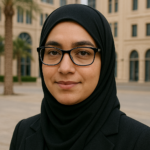
Rawdha Almeraikhi serves as the Outreach Director at MBZUAI